CIP 3 - Crazing Concrete Surfaces

August 28, 2026

Share this article

WHAT is Crazing

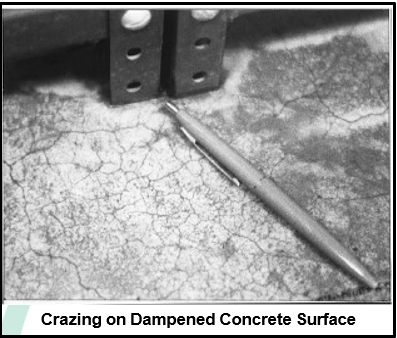
Crazing is the development of a network of fine random cracks or fissures on the surface of concrete or mortar caused by shrinkage of the surface layer that is rich in paste or mortar. These cracks are rarely more than ⅛ inch [3 mm] deep and are more noticeable on steel-troweled surfaces. The irregular hexagonal areas between cracks are typically no more than 1½ inch [40 mm] across and may be as small as ½ or ⅜ inch [12 or 20 mm] in unusual instances. Generally, craze cracks develop at an early age and are apparent the day after placement or at least by the end of the first week. Craze cracking is more visible when the surface is drying after it has been wet.

Crazing cracks are sometimes referred to as shallow map or pattern cracking. They do not affect the structural integrity of concrete.

Craze cracks are generally not a precursor to future deterioration, durability, or wear resistance, especially in interior slabs. Crazed surfaces can be unsightly and cracks can become more obvious as dirt gets embedded in them.

WHY Do Concrete Surfaces Craze

Concrete surface crazing usually occurs if one or more good concrete practices are not followed during installation.

A

Placing a concrete mixture with a higher slump by addition of excessive water. This causes concrete to segregate and create a paste or mortar rich layer at the surface with finishing operations. It also delays setting and increases bleeding.

B

Placement methods, especially on higher slump concrete, that depresses coarse aggregate below the surface and results in an excessive concentration of paste or fines at the surface. These can include the use of a jitterbug, vibratory screeds, or excessive or improper floating with an inclined blade that creates too much pressure on the surface.

C

Finishing while there is bleed water on the surface or the use of a steel trowel at a time when the smooth surface of the trowel brings up too much water and cement fines. Use of a bull float or darby with water on the surface or while the concrete continues to bleed will produce a high w/cm ratio, weak surface layer which will be susceptible to crazing, dusting, and other surface defects.

D

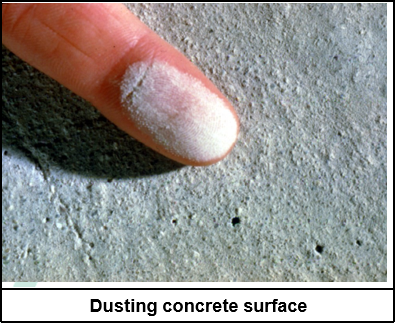
Sprinkling cement on the surface to dry up bleed water on concrete surfaces is a frequent cause of crazing. This concentrates fines on the surface. Spraying water on the concrete surface to facilitate finishing operations will result in a weak surface susceptible to crazing or dusting.

E

Premature finishing of concrete when the surface appears to be dry should be avoided. Conditions that increase evaporation from the surface include low humidity, high temperature, direct sunlight, or high wind velocity. Delayed setting of the underlying concrete due to temperature differences between the surface and the base can exacerbate surface drying. Mixtures with a w/cm below 0.45 and containing supplementary cementitious materials will have lower bleeding.

F

 Lack of or delayed curing will result in crazing and other surface defects. Curing should begin immediately after final finishing. Intermittent wetting and drying the surface will increase the potential for craze cracking

G

Occasionally carbonation of the surface soon after finishing results in crazing as it causes shrinkage of the surface layer. Carbonation is a chemical reaction of concrete with between carbon dioxide and can result if unvented heaters are used. This will result in a softer surface that will dust.

HOW to Prevent Crazing

Concrete surface crazing usually occurs if one or more good concrete practices are not followed during installation.

A

Place concrete at a moderate slump (3 to 5 inches [75 to 125 mm]). Higher slump (up to 6 or 7 inches [150 to 175 mm]) can be used if it is achieved by using mid-range or high-range water-reducing admixtures. These mixtures will be less susceptible to segregation and will bleed less.

B

Place concrete on 3 to 4 inches [75 to 100 mm] compactible granular fill to absorb some water from concrete and reduce bleeding. Moisten the subgrade only if conditions exist for a high evaporation rate. For interior slabs placed on a vapor retarder, avoid adding water to the concrete to increase slump.

C

AVOID the use of jitterbugs and vibrating screeds, especially with concrete with slump greater than 3 in. [75 mm]. DO NOT overwork or over-finish concrete with bull floats or other finishing tools while concrete is still plastic. This results in excessive mortar at the surface. DO NOT perform any finishing operation while bleed water is present on the surface or before the bleeding process is completed. NEVER sprinkle or trowel dry cement or a mixture of cement and fine sand on the surface of the plastic concrete to absorb bleed water. DO NOT sprinkle water on the slab to facilitate finishing. Remove bleed water by dragging a garden hose across the surface. AVOID premature floating and troweling the surface.

D

Start curing the concrete as soon finishing is completed, particularly after hard troweling. At this stage the concrete surface should not be allowed to rapidly dry. Keep the surface wet by either ponding with water, covering it with damp burlap and keeping it continuously moist for a minimum of 3 days, or spraying the surface with a liquid-membrane curing compound. Avoid alternate wetting and drying of concrete surfaces at an early age. Avoid curing with water that is more than 20° F [10°C] cooler than concrete.

E

If concrete has low bleeding characteristics or if evaporation rate is high, protect the surface from drying by using evaporation retarders or other means to reduce the drying of the surface. These precautions will be necessary with slower setting concrete or if concrete is placed on cold subgrade that can cause differential setting.

References

  1.  Guide for Concrete Floor and Slab Construction, ACI 302.1R, American Concrete Institute, Farmington Hills, MI. www.concrete.org
  2. Guide to Residential Concrete Construction, ACI 332.1R, American Concrete Institute, Farmington Hills, MI. www.concrete.org
  3. Concrete Slab Surface Defects: Causes, Prevention, Repair, IS 177T, Portland Cement Association, www.cement.org
  4. Ward Malisch, Avoiding Common Outdoor Flatwork Problems, Concrete Construction, July 1990.

Recent Posts